By Richard Brooks, Stand.earth Climate Finance Director
Two major Canadian banks — Royal Bank of Canada (RBC) and Bank of Montreal (BMO) — recently held their 2025 shareholder meetings. Here’s how they went…
RBC 2025 AGM: A Major Disappointment
On April 10, I attended the Royal Bank of Canada annual general meeting (AGM) for the fourth year in a row. My assessment in one word: disappointing.
Despite 2024 breaking records for deadly fires, floods, and extreme temperatures, there was virtually no proactive mention of the climate crisis by RBC executives, including CEO Dave McKay.
There was even some, potentially intentional, confusion over RBC’s renewable energy financing target: $15 billion by 2030.
Directly to RBC’s executives, I asked why National Bank of Canada set a $20 billion by 2030 renewables target, 33% larger than RBC’s, even though they are a fifth the size of RBC. I was hoping for a commitment to match and surpass this smaller bank.
My hot take:
- No acceptance RBC needs to lead on climate action.
- A lot of justification of financing new oil and gas projects.
- No proactive mention of the climate crisis unless asked.
- No Energy Supply Ratio disclosure.
Despite committing to disclose its energy supply ratio (also known as ESRs, how much funding in renewables versus fossil fuels) from a resolution introduced by the New York City Comptroller last year, RBC has refused to do so. I expected this by now.
BloombergNEF has assessed RBC as the worst amongst the world’s top energy financiers with a ratio of just 47 cents to renewables to every 1 dollar it spends on fossil fuels.
A Shining Light: Indigenous & Community Power
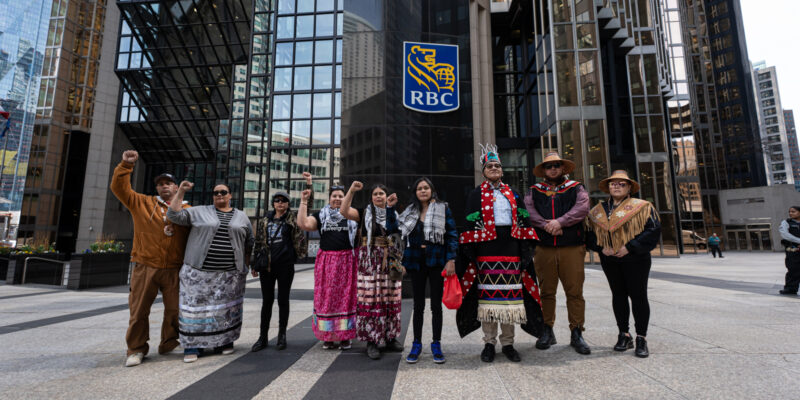
I am empowered and humbled to have joined and supported leaders from B.C. coastal communities, who continue to fight daily and tirelessly against LNG and fossil fuel projects banks are financing or considering financing.
Delegates representing Wet’suwet’en Nation members, Gitxsan Nation members, Union of British Columbia Indian Chiefs (UBCIC), Peace and Unity, Skeena Watershed Conservation Coalition, Indigenous Climate Action (ICA), Change Course, For Our Kids, Decolonial Solidarity and Stand.earth joined together to bring a clear message: respect Indigenous sovereignty, and stop financing LNG.
BMO: Boldly Growing Emissions
On April 11, the day after RBC disappointed investors and activists alike, BMO, led by Darryl White, held its AGM. BMO has done $150 billion in fossil fuel financing since 2016, a major supporter of oil and gas pipeline companies.
BMO’s slogan is “boldly growing the good,” presenting themselves as climate leaders, yet is financing the same projects that banks like RBC are: fossil fuel and LNG projects that do not have consent of Indigenous Nations, and are driving climate chaos.
It’s egregious that BMO continues to finance billions for fossil fuels each year. Disturbingly, BMO has even rolled back its coal financing policy, and has one of the worst ESRs amongst the world’s top 100 energy financiers, including bankrolling dangerous new LNG projects in BC. That’s not leadership.
Pointing to overwhelming public opposition and new evidence of looming financial and environmental risks, we challenged Canada’s top fossil fuel funders to adopt climate-safe, future-focused investment strategies that prioritize long-term economic stability over short-term profit.
The Fight Ahead: No LNG, No Polluting Pipelines
Together, we highlighted polluting proposed pipelines, like LNG Canada Phase 2, Coastal GasLink Phase 2, Prince Rupert Gas Transmission pipeline (PRGT), and Ksi Lisims, warning executives and shareholders of the risks involved in financing new projects that may be unprofitable before they are even built.
These projects present clear economic, climate, and reputational risks, which are not consistent with either bank’s own climate policies, not to mention violate Indigenous Free, Prior, and Informed Consent (FPIC) and human rights.
If we need affordable, accessible energy, we need renewables, not LNG. LNG is more expensive than renewables; it’s also not inevitable.
We have the opportunity to choose a safe, sustainable economy that puts our health and safety before profit, scarcity and greed; to have energy security, independence, and access. It’s time to fund the future instead of the polluting past.
Share This
Array